27 January 2020

2020 Trivia Night Silent Auction Features Unique Art

(Thanks to StLGS VP-Programs and Trivia Night chairperson, Karen Goode, for her assistance in writing and gathering information for this week's blog post.)

St. Louis Genealogical Society’s eleventh annual Trivia Night is now just a couple weeks away, and we hope you can join us for a few hours of brain teasers and good cheer on Saturday, 7 March 2020 at the Richmond Heights Community Center. Trivia Night is fun for all of us at StLGS, and we rely on this annual event as one of our major fundraisers. It is an evening filled with friendly competition and a lot of laughs. Of course, you can learn more on the StLGS website!

One of the highlights of this special evening is our silent auction, a win-win for both you and the St. Louis Genealogical Society. The Trivia Night committee has been hard at work for the past few months gathering donations by members and friends, and we would like to whet your appetite in this week's blog by featuring some of the stunning artwork they have acquired for the auction.

"The Old Courthouse" by Frank W. Bruning (1922–2008)

This charming painting of the Old Courthouse measures approximately 27 by 23 inches and has a value of $100. It was donated by former StLGS member, Pat Thompson. The artist was a WWII veteran of the U.S. Navy and is buried at Jefferson Barracks National Cemetery.


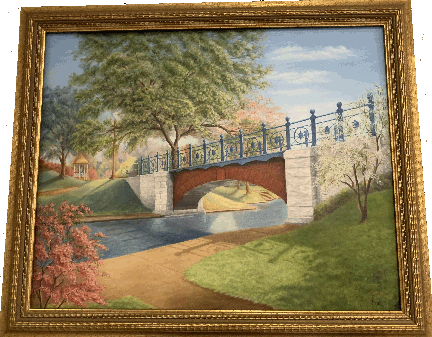
"Bridge in Benton Park" by Dorothy Marie "Dot" Everding Guise (1929–2014)

Dot Guise was a gifted artist who lived in South St. Louis most of her life and worked at the Guise Studio. She specialized in enhancing photos with oil colors. This beautiful example is 36 by 29 inches, has a value of $150, and was also donated by Pat Thompson.
 
 
Vietnamese Hand-Sewn Pictures by the Hong Ngoc Fine Art Company;
Produced in the Chan Thien My Company Workshop for Disabled People

This company was founded in 1996 by a Vietnam veteran who returned to help those who had been affected by chemical warfare. The company's goal is to provide vocational training and jobs to disabled people. These two pieces are both hand-sewn. On the right, the black and white image of a Vietnamese person on a bike measures approximately 14 by 17 inches and is worth about $100. On the left, the image of the person carrying produce is about 16 by 20 inches and is valued at $150. Both were donated by StLGS member, Diane Broniec. To see the Vietnamese artists at work creating original images and sculpture, check out their YouTube video.


 "Spectacular Spirographics" a miniature quilt by Jean Ameduri

Based on a design created by a child's spirograph toy, this machine-quilted piece is approximately 22 by 22 inches and is all cotton with a thin polyester batting. The Swarovski crystals in the center of each design make the piece hand-washable only. The quilt is a perfect wall hanging; in fact, it is thin enough to be secured on drywall with straight pins. The value of this colorful original is $250, and it was donated by its creator and StLGS member, Jean Ameduri.
(All photos by Ilene Murray, © 2020)

We have more auction items to preview in the coming weeks and hope to see all of you at Trivia Night so you can join in on the bidding!


20 January 2020

Great-Grandpa Paid $300. How Much is That Worth Today?

The deed in front of you shows that your great-grandfather bought a piece of property in 1857 for $300. Do you wish you had some way of knowing how much that was worth today? Or perhaps you are looking at the 1860 census that reveals Great-grandpa owned personal estate of $2,000 and real estate of $8,000. Was he rich or just comfortable? Luckily, there are some excellent websites that will help you answer these questions and we will look at two of them this week.

MeasuringWorth: https://www.measuringworth.com/

The MeasuringWorth foundation is a non-profit group located in Illinois and the website is used by economic historians around the world. Hence, this is not a site for those who are looking for something simple. The focus of the site is on understanding relative worth in the U.S., the U.K., Australia, and Spain, and to provide comparators (devices for comparing similar objects and similar measures) for that purpose. The site stresses that "there is no one standard measure for comparing what a monetary value in the past is worth today," so it will give you multiple answers based on available data. You can go directly to a search from the links on the left of your screen, but a better idea is to begin by looking at the User Guide located under a tab in the navigation bar.


The User Guide will help you understand how the comparators work, and then you can do your search by clicking on the Relative Values links on the left or do a walk-through by clicking on the Tutorials link.

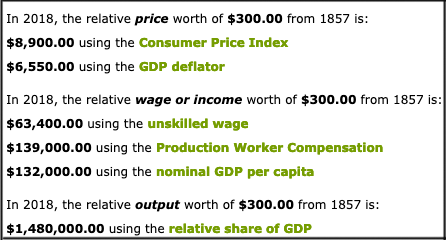
When you are ready to determine the relative current value of Great-grandpa's land, fill out the form (which only goes to 2018) as shown. You also have the choice to get a calculation based on today's Consumer Price Index (CPI) and you can see your results in a table format by clicking in the small white box. The results are sorted by relative price, relative wage or income, and relative output or project, and we learn that the land in 2018's prices would be worth between $6,500 and $8,900.
 

The Inflation Calculator: https://westegg.com/inflation/

A site with far fewer bells and whistles but still very helpful is The Inflation Calculator, maintained by a man called Morgan Friedman. This site uses the Consumer Price Index as well as government statistics and calculates prices from 1800 to 2019. The home screen is simply a form that asks for the amount and the years. When you have the fields filled out, click on "Submit" and get the results in just a few sentences. As you can see, that land is worth about $8,300 in this calculation. An interesting note, here, is the prices reversed at the bottom, so we discover that if Great-grandpa paid $10.62 for something in 1857, that would be worth $300 today.


Understanding that these are variable numbers is important in calculating the then/now value of money but either of these websites should help to give you perspective on your ancestors' worth.


13 January 2020

Two Must-See Websites for Online Maps

At some point, almost every genealogist realizes that geography is as much a part of researching their family as history is. Pinpointing the location of Great-Grandpa Daniel's land is dependent on county boundaries, which were ever-changing for hundreds of years. Where the family settled was often determined by proximity to a source of fresh water, or perhaps the ability to acquire land cheaply. Migration routes followed set pathways of least resistance using rivers, mountain passes, and old hunting trails carved by Native Americans. Having a source at your fingertips for looking at old maps is important, so here are two of our favorite genealogy-oriented map sites.

David Rumsey Map Collection: https://www.davidrumsey.com/


One of the best online collections of maps is available on David Rumesy's Map Collection, which provides a vast assortment of maps from all over the world. The physical collection on which the website is based is housed at the Stanford University Library. Currently, the online collection has more than 95,000 maps, ranging from the sixteenth century to the present and encompassing almost the entire globe as well as the sky and the seas. The home page has dozens of links to all parts of the collection, and that's where you will want to start your search. Scroll down to the center of the page and click on any of the small square icons to search a predetermined category.

Alternatively, you can go to the alphabetical list of maps or browse by category. To access either, use the tab called View Collection in the navigation bar at the top of the home page. Now you can narrow your search by specifics to find exactly what you might want.  The resulting search screen will show you what is available in the category in which you searched and offer you more options for narrowing down, if you need to.
 

The site has numerous ways to view and save maps. It also has ways to overlay old maps onto new and to utilize Google Earth and Google Maps in very creative ways. You will want to bookmark this site (or add to your favorites) so you can keep going back!

Map of US.org: https://www.mapofus.org/

Another real necessity for genealogists is the ability to see United States county boundary lines as they changed over time and, although there are many fancier county progression maps online, this website is also a treasure trove of much more. Everything about this site is simple and easy, but don't be deceived. There is an abundance of detail hidden beneath the plain façade.

The home page has no bells or whistles, just a list of states and some explanation of why maps are helpful. Click on any state of interest, however, and let the fun begin. Scroll down to get the interactive map of changing county borders and click the "play" button to watch the counties form. You can hit the "stop" button at any time to read the text and view the list of dates and links to individual counties. These links take you to the Random Acts of Genealogical Kindness website (where volunteers are waiting to help.
But don't stop there. Keep scrolling down on each state's page for additional resources. Some states have highway maps of each county (at press time, however, both Missouri and Illinois had non-working links on their maps) and some states have links to other websites with historical maps. There are also links to many other state maps and atlases. 

The navigation bar at the top of the page will take you to additional maps of the U.S. and to a range of historical atlases. You will have no shortage of links to explore on Map of US.org!

These are just two of our favorite online map websites that can help you locate locate your ancestors. Enjoy!


31 December 2019

StLGS Surname Files Index Updated and Online


(Thanks to Judy Belford, our Reference Room librarian, for contributing this week's blog post.)

The St. Louis Genealogical Society Surname Files Index is back online! The index has been down for several months as we inventoried the surname folders in our office, sorted them, and reassessed the collection. The files are made up of a wide variety of material that has been donated to the society over many years by members and friends. We currently have folders on nearly 2,700 surnames. Each surname is listed only once in the index and may refer to a single postcard or to multiple folders of the same or different families.

You can access the Surname Files Index on our website. Since this is such a long index, be sure you select the “Show More Results” link at the end of each screen to see all of the names.

The contents in each file can vary widely, but may contain items such as:
  • Pedigree charts
  • Family group sheets
  • Correspondence
  • Newspaper articles
  • Photocopies from books or journals
  • Research notes
Neither the files nor their contents may be removed from the office, but anyone coming into the office to use the files may make paper copies as desired for a nominal fee. Or, if you bring your smart phone or camera, you are welcome to take photographs.

Because of the inconsistent nature of materials in the files, we recommend that you contact the reference room librarian to learn the contents of a file before coming into the office.

We are once again accepting new material for surname files. Donations must be genealogical in nature (no photograph albums, scrapbooks, baby books, or personal memorabilia) and have some connection to St. Louis. The StLGS librarian reserves the right to edit the contents of donated surname material before adding anything to our collection. For more information or if you have questions about what or how to donate, please send an email to library@stlgs.org or call the office at 314-647-8547 during office hours and ask for the reference room librarian.

23 December 2019

Hands-On Experiences Enhance Genealogy

(This week's blog was written by StLGS member, Janet Foss, who shares some serendipitous travel experiences—and photos—in her quest to learn more about her ancestors. Hopefully, Janet's successes will inspire you to hit the road too, once the weather warms up. And from all of us at St. Louis Genealogical Society, a very happy/merry Chanukah/Christmas!)
 

Unexpected Finds

My husband and I travel quite a bit in an RV. We both love history. Whenever we are on the road, we seek out museums and historical sites. Lucky for me, our summer travels have provided several unexpected encounters that have enhanced my genealogy.

On a trip to Springfield, Illinois, I discovered that I was near Camp Butler National Cemetery. Just a week earlier, I had learned that my 2X great-grandfather reported for military service in January 1865 at Camp Butler. I hadn’t yet taken the time to determine where that might have been and here it was jumping off the page of a local travel brochure. In addition to being a troop processing center, the camp had a hospital, which necessitated the need for a cemetery. Although the camp is long gone, several photos and placards outside the cemetery office described the camp and subsequent national cemetery.

A month later, while spending time in Lexington, Kentucky, we visited Camp Nelson National Monument, a Civil War site and new addition to the National Park Service. While we were browsing through the museum, a volunteer pointed out a small re-created sutler’s store. Holding up one of the shoes in the display, the guide explained that there were three sizes––small, medium and large––and no right or left designation. (No arch supports or insoles either!) Suddenly I recalled my 3X great-grandfather, a boot and shoemaker in 1860s St. Louis. This was just what he would have been making.

Then while visiting Keokuk, Iowa, we toured the beautiful Victorian mansion of Samuel Morgan Freeman, a prominent citizen and attorney. Sitting on a side table In Freeman’s office was a Blickensdoerfer typewriter. George Canfield Blickensdoerfer, the inventor of this version of the typewriter, was a distant cousin of mine. Up to this point, I had only seen a picture of his invention. Here was the real thing, complete with the wooden carrying case.

Of course, we photographed these wonderful discoveries to add to my ever-growing collection of genealogy materials.

Perhaps what I am saying is that we can learn so much about our ancestors’ lives in many ways if we just remain open to them. We all spend countless hours searching databases on the Internet and scrolling through microfilms and other resources in the library. These are certainly invaluable tools in researching our family history, but making stops at museums, historical sites, and other places can provide a rewarding glimpse into our ancestors’ lives and help us piece together their stories.

16 December 2019

Enjoy a History Staycation in St. Louis

 Missouri History Museum in Forest Park: Mighty Mississippi

There is nothing like a holiday weekend with out-of-town company to get you off the couch and finally visiting two wonderful St. Louis venues that are all about history. If you ever wondered how much of an influence the Mississippi River has had on St. Louis, head over to the Missouri History Museum in Forest Park to see the "Mighty Mississippi," a special exhibit that opened in late November and will remain in place until April 2021. Encompassing more than four hundred years of history, this slice of life in the Mississippi River watershed includes information on many of the religious and ethnic groups that lived and worked along the river and settled the city.

A sensory delight of panoramic displays, artifacts, and hands-on video and audio stations, the exhibit takes you through time, introduces you to many of the important people in the city's history, and keeps you engaged and fascinated as you learn more about how the river has supported life for generations. Learn more about the exhibit on the Missouri History Museum's website.


While you are at the History Museum, don't miss the extremely moving exhibit of Pulitzer Prize winning photographs. This exhibit will close in just a few weeks—on 20 January 2020—and is absolutely stunning in its raw depiction of the highs and tragic lows from 1942 until the present. You will undoubtedly remember seeing many of these photos when they first were published. They are intense in their revelations of war, crime, bigotry, and tragedy as well as breathtaking in their celebration of life, triumph, and love. For those of you with an interest in history, this one is a must-see, but be forewarned, some of the images will stay with you long after you leave the gallery!


The Museum at the Gateway Arch

Sure, it's always fun to ride up to the top of the Arch to see the panoramic view on a clear day, and it is really a must-do activity when friends or family visit from another city. However, within the past year, the museum under the Arch has undergone a massive renovation and is really worth a visit on its own merits. There is also a new café adjacent to the museum where you can get a snack or a meal.

The exhibits in the newly-expanded museum are bright, packed with information, and guaranteed to pique your interest.  Beginning with Native American settlement, the chronological history of the city and its environs is told in an inclusive and eye-opening manner. You will learn more about the early Native American and Creole inhabitants, the pioneers, the adventurers and fur traders, the immigrants, and the quest to keep moving west. An additional gallery reveals many details on the actual construction of the Arch in the 1960s. Learn more about the museum and check out what is in each of the galleries at the National Park Service's website.

Since the Gateway Arch is now under the auspices of the National Park Service, you do need to go through a security checkpoint before entering the museum. You may not have any weapons with you, and purses, backpacks, etc., will go through a conveyor belt while you walk through an airport-style security machine. There is a  small entrance fee to the site and an additional charge to ride up to the top. If you have a National Park Service pass, you will get a discount on the fees. Get help planning a visit on the Gateway Arch's website.


Why not plan to visit these two wonderful local museums while you have some time off this winter? You will gain so much insight into the history of our city when you do!


 (All photos by Ilene Murray)

09 December 2019

2019 Holiday Gift Suggestions for your Favorite Genealogist (or You!)

Lucky for us, there is an abundance of wonderful possibilities for holiday gifts for your favorite genealogist or historian. We offer you the following ideas to make your genie-buddy's holiday just a bit brighter (or to gift yourself!)

St. Louis Genealogical Society
  1. An individual or family membership, just in time for the start of the 2020 year's events and our ever-expanding collection of online databases
  2. Gift certificates, available in any amount, good for discounts on workshops or items in the StLGS store (Check the website for how to order.)
  3. Copies of society publications, such as The War of 1812 in Missouri (volumes 1 and 2) or Orphanage Care in St. Louis; all available in our online store or at the office
Technology-related Gifts
  1. Flash/thumb drives to use in libraries or to move, share, or store files
  2. A portable external hard drive for extra storage or backing up files
  3. A subscription to an online/cloud backup plan such as Backblaze or Carbonite
  4. Extra supplies for digital equipment: memory cards, batteries, portable mini-tripods
  5. A subscription to Ancestry, FindMyPast, Newspapers.com or any similar service
  6. A DNA testing kit (Choose one of the major companies: FamilyTree DNA, Ancestry, or 23andMe. Select the one that has the most people in its database that are similar to your recipient. The more people with the same background in the database, the more accurate the results.)
  7. A genealogy software program or an upgrade to an existing program
  8. Gift cards to the Apple App Store or Google Play Store or to the appropriate store for their particular smart phone or tablet so they can buy additional apps
  9. Gift certificates to local community colleges or adult education sponsors for classes and practice in using technology
Not Technological
  1. Archival quality photo storage boxes or photo albums
  2. Acid-free photo mounting supplies and/or photo marking pens
  3. Acid-free, archival quality sheet protectors and/or paper
  4. Good quality three- or four-inch D-ring binders for storing copies of sheets and documents
  5. Gift certificates to historical/genealogical societies in areas where ancestors lived for membership, publications, and/or special events
Books!

Almost all genealogists are book lovers and you can't go wrong by adding to their collections. Try some of these . . .
  1. Any of the QuickSheets by noted genealogist Elizabeth Shown Mills (or, better yet, her excellent book on source citations, Evidence Explained)
  2. The series of Genealogy at a Glance laminated booklets available in a variety of ethnicities: German, Irish, French, etc.
  3. Books on American states of interest; for instance, any of the NGS Genealogy in the States series
  4. Books that are specific to areas of interest: neighborhoods, religions, occupations, or any other unique aspect of their family history
Remember, as a StLGS member, you are entitled to a discount on many of the products in our online store. Be sure to log in as a member to get your discount code before you shop. Click here to go to the StLGS online store. Or come by the office and see what we have available in our lobby sales area. Have fun doing your holiday shopping or just treating yourself to a gift!